Pilot suits
At the beginning of the 20th century, high-altitude flight presented an unprecedented challenge: how to protect aviators from the cold, lack of oxygen, and pressure variations? The first solutions were rudimentary: simple leather coats, thick gloves, and goggles to protect against the wind. But very quickly, with the rise of military aviation and the exploration of high altitudes, it became clear that specialized clothing was essential.
The early winter suits made of leather and fabric, lined with fur or felt, as well as the sheepskin suits discussed in Chapter 4 and the electrically heated suits presented in Chapter 5, were not the only outfits developed for Army aviators. Uniform designers used a wide variety of linings and outer fabrics to meet diverse needs.
 Jumpsuits lined with blankets
From the First World War onwards, research was conducted on the use of blanket-type materials to line flight suits, and experiments continued during the 1920s. Wool, for example, was used at that time to line the inside of suits made of leather, knitted velvet, or Bedford cloth.
During the winter of 1925-1926, a one-piece, blanket-lined leather winter suit was tested under extreme conditions, with temperatures reaching -30°F (≈ -34°C) at an altitude of 20,000 feet (≈ 6,000 m), during trials conducted by Lieutenant JA Macready, Flight Section Chief at McCook Field, Ohio.

Image caption:
Flight suits used by the Air Corps in 1928.
- Type B-3 face mask
- B-5 type glasses
- B-3 type winter helmet
- B-2 type harness and parachute bag
- B-7 type lined winter coverall
- Two-finger aviator gloves type A-4
- Type A-2 Moccasins
After numerous trials, a lined leather coverall, designated Type B-7 , was adopted as standard on May 12, 1928. It was replaced by a new standard model on June 12, 1931. Although the B-7 was considered "stiff and bulky" by many airmen and not warm enough, some continued to use it until the suit was finally declared obsolete on March 27, 1944.
Variants of the B-7 were also produced, including fur-lined models. Some one-piece examples were split in the late 1930s and listed separately as jacket and trousers in Air Corps stock lists between 1938 and 1943. (Note that this jacket should not be confused with the 1941 Type B-7 winter flight jacket , which was made of sheepskin.)
Jumpsuits made of fabric and lined with sheepskin
A joint Army-Navy conference on flight clothing took place at Wright Field in February 1931. Reports were drawn up on various winter suits made of fabric or lined with sheepskin, tested on this occasion.

Image caption:
Winter flight suit (left) consisting of the Type B-1 jacket and A-1 pants .
Lightweight winter combination (right) consisting of the Type B-2 jacket and the A-2 pants .
These two sets were standardized in 1931 and remained in inventory until 1944.
Two-piece winter suits were introduced to ensure a better fit for the aviator.
During that winter, several outfits were tested to replace the Type B-1 “Monkey” fur-lined winter suit,
- a calfskin leather jumpsuit lined with a lining
- a horsehide leather jumpsuit lined with lambskin
- and a two-piece horsehide jumpsuit
The conference participants decided that the horsehide suit lined with lambskin was the warmest, most flexible, easiest to put on, and most desirable.
It was standardized under the name Type on June 12, 1931
- Jacket B ,
-
A-1 trousers ,
Both were reclassified as limited standard on May 8, 1934, when the Type B-3 sheepskin coverall was adopted.
According to a contemporary newspaper article, the A-1 trousers were unique: when their zippers were opened, they flattened like a blanket. The aviator would put them on by sliding his arms through the suspenders and then zipping the legs closed.
Fiber-lined suits
Two other winter outfits similar to the B-7 were the Types B-8 and B-9 , one-piece and lined with removable silk.
Trials of the B-8 model (experimental calfskin) began in 1930, but it was never standardized. Nevertheless, some sizes (such as 44) remained listed as non-standard items until 1938.
The Type B-9 , made of horsehide, more flexible and lighter than the B-7 or B-8, was accepted as a limited standard on June 12, 1931, and declared obsolete only on March 21, 1944.
The Type B-11 , a lightweight silk winter coverall standardized on June 12, 1931, closely resembled the sheepskin B-10, except for its silk lining. As with the B-10, it was split into two pieces (B-2 jacket and A-2 trousers), adopted on December 15, 1931, then reclassified as a limited standard on May 8, 1934, and declared obsolete on September 29, 1944.
Intermediate and winter flight suits made of bouclé wool fabric
The use of pile fabrics for intermediate and winter flight suits was considered. This resulted partly from the possible shortage of sheepskin clothing during the war, and partly from increasing reports from abroad about the unsatisfactory characteristics of these sheepskin suits.
According to the Willis and Geiger company of New York, the available quantities of alpaca wool were practically inexhaustible, which undoubtedly impressed the leaders of the AAF (Army Air Forces), even though the United States was already engaged in the war. The hair of the alpaca, a domesticated South American mammal related to the llama, had indeed been used in modern textiles, primarily for lining winter clothing.
Comparative tests between sheepskin and alpaca wool clothing
These tests were conducted in December 1942 by the Fabrics Research Laboratory in Boston, under the direction of the AML. The conclusions were as follows:
- Sheepskin had the best thermal insulation qualities, but the weakest insulating power against wind.
- The insulating qualities of sheepskin could be reproduced by a double-layered alpaca fabric, with less than a third of the bulk.
- A tightly woven fabric, such as gabardine or airy canvas, greatly reduced the air permeability of a loose fabric such as alpaca or bouclé wool.
- The air permeability of a garment was a desirable factor, as it prevented the condensation of water vapor inside the fabric.
Trials in Alaska (1942–1943)
Tests conducted in Alaska by the Cold Weather Test Detachment indicated that the multi-layered alpaca clothing then under development could be worn satisfactorily at temperatures of -35°F (≈ -37°C), for 4 to 6 hours.
These results were confirmed at Ladd Field (Alaska), where it was concluded that:
"A combination of clothing made from a warm material such as wool or alpaca, with a windproof outer fabric, proved to be the warmest and most flexible protection for extreme conditions. Sheepskin suits, on the other hand, were less warm, less flexible, and more cumbersome."
Developments and new standardizations
During this period, the Australian polar explorer Sir Hubert Wilkins was engaged as a temporary consultant by the QMC ( Quartermaster Corps ) to work with the Cold Weather Test Detachment . To meet the urgent need for Arctic equipment, the Air Transport Command (ATC) directly contacted the QMC. Thus, during the winter of 1942–1943, several thousand new Arctic suits were supplied by the QMC.
In January 1943, a jacket made of looped wool fabric, the Type B-8 , was standardized for use as an inner jacket with the Type A-7 trousers, manufactured to the same design.
In October 1942, Wright Field launched the development of an intermediate combination: Type B-10 jacket and Type A-9 trousers, as well as a heavy looped wool jacket, the B-11 .
The B-10 (standardized April 7, 1944) was made of water- and wind-resistant olive drab cotton twill and lined with a 50/50 alpaca and boucle wool blend. It featured a sheepskin collar, knitted cuffs, a zipper closure, and two large flap side pockets. The A-9 pants had three leg pockets and two hip pockets. Suspenders were provided. This uniform provided effective protection down to 15°F (≈ –10°C) but could be worn under an F-3 electric heated suit for colder temperatures.
The B-11 (standardized on February 7, 1945) was made of gabardine, with tightening straps at the wrists and a lining made of a thick blend of alpaca and bouclé wool.
The B-11 jacket, while resembling the intermediate B-10 , was distinguished by a sheepskin-trimmed hood instead of a collar. Longer in cut (more like a coat than a jacket), it fastened with an internal zipper and external buttons.
It included:
- two slit pockets for hands,
- two lower flap pockets.
The matching trousers, Type A-10 , were made of cotton twill, had three leg pockets, two hip pockets, a side pocket, and adjustable ankle tabs. They were also lined with wool and alpaca and fitted with suspenders.
Suggested improvements
Further testing and use in real-world conditions demonstrated that these outfits were generally satisfactory, but that certain modifications would be advantageous:
-
Added gussets at the elbows, knees and seat for greater freedom of movement.
-
Using double-sided alpaca wool instead of single-sided, for extra warmth.
-
Integration of a rayon lining for added comfort and easier dressing.
-
Additional slit pockets.
-
Continuous zippers on the leg openings of the pants.
New intermediate combination
These recommendations were incorporated into an improved version: the intermediate combination consisting of the B-15 jacket and the A-11 trousers . Standardized on April 7, 1944, it also included other improvements, such as a higher collar and better overlap between jacket and trousers than in the B-10/A-9.
The following versions (B-15A, B-15B, etc.) incorporated these innovations.

Photo captions
On the left:
Staff Sergeant Joe Urbanoski , radio operator on Martin B-26 of the 322nd Bomb Group (Ninth Air Force), circa September 1944.
He wears the B-10 intermediate jacket and the B-1 cap, usually with the matching A-9 pants.
(Photo source: SI Photo 81-332)
On the right:
The heavy winter suit of 1943, made of alpaca wool, consisting of the B-11 jacket and the A-10 pants.
(Photo source: SI Photo A4866F)
Evolution of intermediate combinations
The B-15/A-11 combination had the same general appearance as the B-10/A-9 combination. The same adjustable suspenders could be used with the A-9, A-10 and A-11 trousers: they were made of olive drab cotton elastic webbing (specification 3221), 1 to 1.5 inches wide, with all metal parts zinc-plated and lacquered black.
At the end of 1944, some minor modifications were made to the B-15/A-11 combination. It was redesigned and standardized as Type B-15A (jacket) and Type A-11A (trousers) on November 4, 1944 .
Small triangular tabs were added to the upper right and left sides of the chest, serving as attachment points for the oxygen tube clamps.

On the left:
Heavy flight suit lined with alpaca, consisting of the B-11 jacket and A-10 pants, worn over the intermediate B-10/A-9 suit.
The shoes are probably A-14 mukluks .
The set is completed by an AN-H-16 helmet and B-8 goggles.
(Photo source: SI Photo A4866G)
On the right:
Intermediate flight suit, 1944.
A C-54 navigator wears the B-15 jacket and A-11 trousers, with the following additional items:
- AN-H-15 helmet,
- A-14 oxygen mask,
- A-11 gloves,
- A-6A boots.
(Photo source: SI Photo A4866H)
Improvements to the Type B-15A (late 1944)
In the fall of 1944, the intermediate combination consisting of the B-15A jacket and the A-11 pants was modified.
The improvements included:
- the addition of a metal communication tab attached to the left side of the chest,
- small triangular tabs sewn onto the upper right and left parts of the jacket, serving as attachment points for the oxygen hose clamps ( demand type),
- an additional box-shaped pocket with flaps on the left thigh of the trousers, designed to hold the hose of the emergency oxygen kit,
- the relocation of the pocket intended for the emergency oxygen cylinder, raised by 7–8 cm in order to reduce the risk of knee injury during a parachute jump.
- The latest modifications incorporated into this outfit were based on operational experience, including the addition of a rayon lining over the alpaca insulation.
On May 21, 1945 , the improved jacket was adopted as the new standard under the name B-15B , officially replacing the B-15A. The trousers were also slightly modified.

Another view of the successful intermediate B-15/A-11 combination, with A-11 intermediate helmet, B-8 goggles, A-14 oxygen mask, A-11 gloves, A-6 boots, and B-4 life jacket.
(Photo source: SI Photo A4861H)
The suits lined with synthetic and natural fibers
On June 4, 1945 , the A-11B combination was adopted as the standard.
Most of these garments lined with synthetic fibers ( pile fabrics ) remained in use in the AAF and later in the USAF for many years after the war.
Advances compared to sheepskin outfits
The use of long-pile industrial textiles marked a significant improvement over shearling suits.
- Less bulky,
- More resistant to crushing,
- Retains heat better even after repeated use.
- Another advantage was the possibility of layering these garments with other clothing. Insulation could thus be adapted to flight conditions, something that was difficult to achieve with a single, heavy sheepskin garment.
Association with heated suits
The greatest development of these garments was their combined use with electric heated suits .
Used together or separately, they offered effective protection against the low temperatures encountered in flight, while being relatively lightweight and allowing good freedom of movement.
Quilted down and feather suits
Among the first types of flight suits tested were those made with:
- an outer shell made of wind-resistant fabric,
- a quilted lining filled with down or feathers.
- These models were designed to provide both warmth and lightness.

Below :
Lieutenant JA Macready wearing a down-filled quilted flight suit, intended for high-altitude flights, during a flight in 1921 at 40,800 feet (approximately 12,400 m).
This experimental outfit proved to be warm and light, but its materials were not reliable enough for regular use.
We can also distinguish the oxygen mask and the fur mittens.
(Photo source: SI Photo A48678)
Down quilted jumpsuits
From the earliest years, quilted suits with down or feathers were constructed and tested at the Air Service Clothing and Parachute Branch in McCook Field, Ohio.
The trials convinced Major EL Hoffman , head of the Equipment section, that these suits, although warm, were too bulky.
He then proposed:
- to replace down with kapok (a plant fiber used in life jackets),
- to trim only certain parts, such as the legs and sleeves, rather than the entire garment.
- Hoffman believed that this provision:
would offer greater freedom of movement,
- would also allow the pilot to float in the event of a forced water landing.
- The possibility of using such clothing as buoyancy suits increased their appeal.
- However, the question of modifying the thickness according to flight conditions remained a major challenge.
Experiments and limitations
Lieutenant JA Macready , head of the flying section at Wright Field, wore a quilted jumpsuit during his famous high-altitude flights in the early 1920s.
During one of these flights, he reached 40,800 feet (12,400 m).
Although the garment proved satisfactory in terms of warmth and lightness, the materials used were not durable enough for everyday use.
Thus, despite regular testing during the 1920s and 1930s, these combinations remained marginal.
Standardization in 1943
It was only in September 1942 that serious work resumed to develop a modern quilted down garment.
The results of the tests impressed the AAF School of Applied Tactics and the Board of Equipment in Orlando, Florida, who compared them to sheepskin suits.
Result :
- Officially adopted on July 22, 1943 .
- under the designation jacket B-9 and pants A-8 .
The jacket was made of olive green gabardine, lined with satin filled with down.
It had a front zip fastening with external buttons, and a lined hood.

A B-17 crew member wears the heavy quilted down winter suit (standardized in 1943).
- B-9 jacket,
- A-8 trousers,
- A-12 mittens,
- A-6A shoes.
(Photo source: SI Photo A4867F)
A sheepskin-lined hood was provided.
The trousers were made of olive green cotton twill, with a quilted lining.
It featured three leg pockets, two hip pockets, and adjustable shoulder straps.
In total, 50,000 B-9 (jacket) and A-8 (trousers) sets were produced.
In practice, however, these combinations proved to be very cumbersome .
Indeed, the huge contracts made for sleeping bags with the QMC (Quartermaster Corps) and the AAF made it impossible to obtain 100% pure goose down.
Instead, a mixture of 40% down and 60% feathers was used, which made the garment so stiff that it no longer resembled the early soft and light models filled with pure down.
Production was therefore interrupted in early 1944 .
Summer flight suits
Lightweight suits or summer flight suits were originally designed to protect aviators' clothing from oil and dirt, and to offer some protection from the wind.

Down-filled quilted winter suit, including the B-9 jacket and the A-8 pants.
Additional equipment visible:
- AN-H-16 helmet,
- B-8 glasses,
- A-14 oxygen mask,
- A-12 mittens,
- olive green wool sweater
- A-14 mukluks fur-lined boots.
(Source: SI Photo A4867E)
On the right:
Type A-3 (1928) summer jumpsuit, equipped with zippers on the front, sleeves and ankles.
It remained in limited use until 1944 .
(Source: SI Photo A4867J)

On the left:
Type A-4 summer flight suit, manufactured during World War II.
Although officially replaced by the Army and Navy's AN-S-31 combination in 1943, the A-4 continued to be widely used until the end of the war and remained in service with the USAF during the Korean War.
Visible equipment:
- AN-H-15 helmet,
- AN-6530 Glasses,
- Parachute S-1 or AN6510-1 (seat model).
(Source: SI Photo 81-313)
On the right:
Type A-4 summer flight suit dating from 1930 .
It was made of olive green gabardine.
The A-4 was comfortable and remained in service from the days of open cockpits until the jet age.
(Source: SI Photo A4868)
Lightweight flight suits (continued)
Lightweight flight suits were designed to protect aviators' clothing from oil and dirt, while also providing some protection from the wind.
With their closures adjusted at the wrists and ankles, they prevented cold drafts and also limited the risk of clothing snagging on levers or exposed parts of the aircraft.
During the First World War
Air Service aviators used a lightweight, unlined, one-piece suit, similar to a mechanic's overalls.
However, many pilots preferred to wear the service uniform, with helmet, goggles, gloves, and sometimes a light flight coat when operating in hot weather and at low altitudes.
This practice continued after the war, although lightweight one-piece flight suits were produced in small quantities in the 1920s.
Developments of the 1920s–1930s
The Type A-1 and A-2 coveralls, developed and put into service in the mid-1920s, were respectively made of gabardine and olive green cotton.
- The A-2 was only used in a limited capacity.
- The A-1 , meanwhile, continued to be used until the 1930s.
Two sizes of this now obsolete model were still listed in Air Corps stock lists as late as September 30, 1942 .
These two uniforms were officially replaced by the Type A-3 , made of olive green cotton.
It had a pleated front pocket, a front zipper and two chest pockets.

Major Gust Lundquist (left) and Major Frederick Borsodi , test pilots, in front of a Focke Wulf Fw-190 captured in April 1944.
Both are likely wearing the Type A-5 summer flight suit, very similar to the A-4 but with additional zippers at the chest and legs. Note the special visor mounted on the B-8 goggles.
(Source: SI Photo 80-20359)
Summer flight suits
The A-3 suit continued to be used in limited quantities until it was finally declared obsolete on March 21, 1944 .
The well-known A-4 , made of olive green gabardine, looked very similar to the A-3.
It was standardized on March 18, 1930 and widely used before, during and after World War II.
The war version of the A-4 had:
- a front zipper,
- a chest pocket placed diagonally on the right,
- and a pocket on the right leg just below the knee.
- The A-5 suit was identical to the A-4, except that it was slate blue in color and had zippers on the chest and side pockets.
It was standardized on June 23, 1937 , but saw very limited use.
A moleskin summer jumpsuit was listed as non-standard in stock lists published from June 1, 1940 to September 30, 1942.
Only three sizes were available.
The A-6 coverall was standardized from July 18 to October 16, 1944 , before being quickly abandoned.
It was produced in small quantities, in cotton twill or gabardine, and resembled the AN-S-31 Army and Navy coverall, which was standardized for joint use on April 23, 1943 .
General reviews
Unlike winter outfits which were deemed insufficiently warm, summer jumpsuits were often criticized for being too warm for use in hot climates .
The crews sometimes improvised:
- In areas like China, some people cut the sleeves off their suits for more comfort.
- Others preferred to fly simply in khaki uniform, without protective suits.

The AN-S-31 summer coverall, standardized in 1943 for the Army and Navy.
The model shown here, in lightweight khaki canvas, bears the label: “Suit, Summer, Flying, AN-S-31A.”
This type was produced in large quantities and in various fabrics.
Visible equipment:
- AN-H-15 helmet,
- B-8 glasses.
(Photo from the NASM collection – SI Photo 81-321)
Evolution of summer flight suits
During the summer of 1942 , an investigation was conducted among the crews stationed at a Hawaiian base.
The main characteristics desired for a summer jumpsuit were:
-
Flexibility , considered paramount.
-
Fire protection is highly desirable.
-
Buoyancy , in case of water landing.
-
Lighter, cooler clothing for use on the ground.
-
Better fit , in order to reduce the risk of snagging inside aircraft and to give a neater appearance on the ground.
-
No cold-related problems were reported.
AN-S-31 Model Standardization
An agreement between the Army and the Navy resulted in the development of the AN-S-31 summer suit, designed as an improved version of the A-4.
It was standardized for joint use on April 23, 1943 .
Approximately 250,000 units were produced in 1943 to gradually replace the A-4 suit.
The AN-S-31 remained in service with the AAF and USAF well after the war.
Manufacturing and variations
Two versions existed:
- a fabric blending 50% cotton and 50% wool ,
- and a version in cotton twill .
They were judged generally satisfactory, but some improvements were recommended:
- better fit,
- More effective windproof wrist closures,
- zipper extending down to the crotch.
These modifications were incorporated into later models, which saw many variations, particularly in fabrics and colors.
A very lightweight model, made of poplin or Byrd cloth , was even produced to meet the needs of tropical areas (hot climate and mosquitoes).
All versions (cotton/wool or cotton) offered, in addition to zipped pockets , a clear advantage.

Below :
The AN-S-31 summer flight suit became very popular and was used by the AAF and then the USAF for several years after the war.
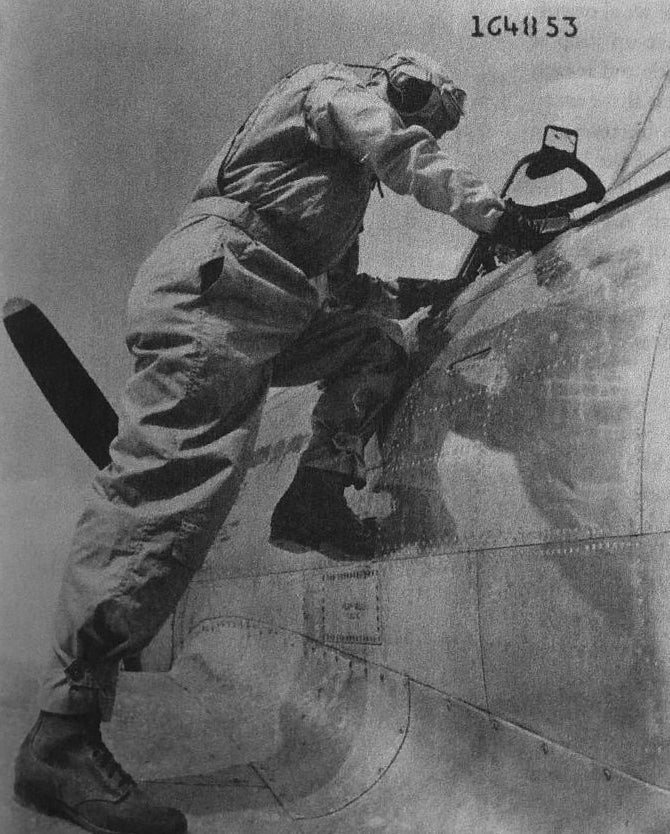
In the photo, a P-47 pilot is wearing a pair of experimental Type E-2 "escape" shoes tested in 1944, as well as the AN-H-15 summer helmet with B-7 or AN-6530 goggles.
(Source: SI Photo A4868C)
AN-S-31 type summer flight suits
The Army-Navy summer suit (AN-S-31) was usually made of khaki or olive green fabric, with a label bearing the inscription AN-6550 or AN 6550-AN-S-31 , or of a lighter light green fabric, labeled AN-S-31A (probably a modified version).
Another variant in grey-green fabric was marked AN-S-31-M44 .
A one-piece summer version, with a front zipper, made of light green fabric, bore the designation AN-6550-M34 .
The designations M44 and M34 indicated the size, for example: average size 44 or 34.
General characteristics
A typical AN-S-31 or AN-6550 combination featured:
- a unique, unlined piece, in lightweight gabardine or cotton twill,
- a zipper,
- tightening straps at the ankles and hips,
- side pockets with buttons and flaps,
- access openings on the sides to reach the interior pockets,
- a pleated gusset at the back to improve freedom of movement,
- a pointed collar (different from the rounded collar of the Type A-4),
- and a zipper with locking mechanisms at both ends.
Developments in 1944
A modified version of the AN-S-31 and the A-6 was developed in 1944 for the AAF.
Two variants were standardized on November 3, 1944 :
- Type K-1 : made of very lightweight cotton twill (called Byrd cloth ),
- Type L-1 : in combed wool gabardine, trimmed with cotton.
These two models were produced in limited quantities.
Their features included:
- a looser fit with a pleated back
- a zipper extending down to the crotch,
- and a design offering greater freedom of movement.

Below :
Very lightweight summer flight suit in cotton twill Type K-1 .
Developed in 1944 for AAF personnel operating in tropical or hot climates.
Visible details:
- leather case sewn onto the left thigh for cards and checklists.
- AN-H-15 summer helmet,
- AN-6530 glasses,
- A-10A oxygen mask,
- GI standard issue knee-high boots.
(Source: NASM – SI Photo 81-319)
Developments in lightweight flight suits
The suits were fitted with a zipper at the bottom of the legs , making them easier to put on and take off.
The pockets were also improved: these models had diagonal chest pockets, as well as two leg pockets and two hip pockets, all equipped with zippers.
A leather card holder was attached to the left thigh of most suits, and a pencil pocket was located on the left sleeve.
Variants of the K model
The Type K-1A , similar to the K-1 model, was distinguished by modifications to the cuffs and belt, using snap fasteners .
The Type K-2 also resembled the K-1 model but was made of loosely woven nylon .
It was probably distributed at the same time as the L-1A suit after the war.
Development of the K-2 models continued in the USAF, and the K-2B became a standard USAF flight suit, used until the Vietnam War.
Variants of the L model
The L-1A retained the design of the L-1 but included the same improvements as the K-1A.
An L-1B version, in sage green, appeared after the war.
The L-2 , meanwhile, featured an outer shell made of cotton twill , lined with wool-rayon , with an integrated hood .
General summary
With the exception of the L-2 , all of these summer suits remained in service in the AAF and then the USAF for many years after World War II.