Lightweight Flight Jackets
From the First World War onward, military aviators began using leather jackets specifically designed for flight. These jackets were among the first essential pieces of equipment for pilots. Both short and long models were worn until the 1920s, although their production gradually declined. The French Air Force still held some models in its archives until the early 1940s.
These jackets were replaced by the Type A-1 summer jacket, made of soft leather with knitted collar and cuffs, adopted in 1927. Although it was used until during the Second World War, it disappeared permanently from inventories in 1944.
In 1930, a new model appeared: the famous Type A-2 summer jacket. Designed to be more practical and durable, it quickly became the iconic uniform of American aviators. Officially standardized in 1931, it was worn continuously throughout the following decade and during World War II.
The A-2 jacket, like the 1950s "crush" cap, acquired a lasting reputation and remains a symbol of military aviation style to this day.

Photo caption:
The A-2 summer jacket was a favorite among military pilots. A true classic, it saw service in numerous theaters of operation. Here, an officer from the 390th Bomb Group wears it with an AN-H-15 helmet and AN-6530 goggles.
The A-2 Jacket
During World War II, the A-2 jacket became both a practical garment for aviators and a true status symbol. Although a newer model, the AN-J-3, was adopted as its replacement in 1943, the A-2 remained extremely popular with pilots and continued to be worn on almost every front.
Made of brown horsehide and lined with lightweight silk, it featured a turn-down collar, a zipper closure, and knitted trim at the cuffs and waist. Unit insignia were often sewn onto it, sometimes accompanied by the pilot's name or distinctive symbols. Markings could be located on the chest, shoulders, or even the back.
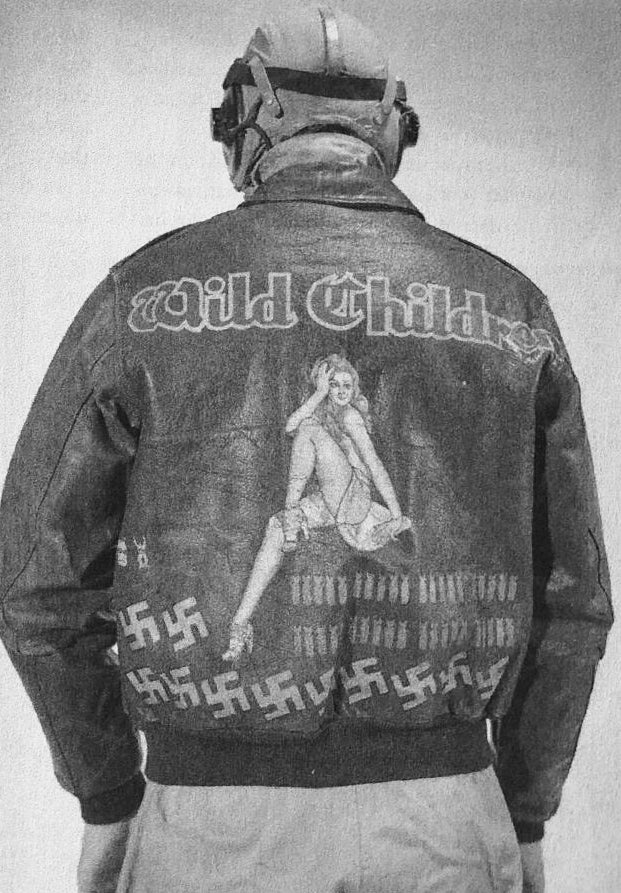
During the war, some airmen personalized their jackets with paintings applied directly to the leather. These decorations frequently depicted pin-up girls, patriotic scenes, or the insignia of the bombers on which they served. This practice, initially tolerated, eventually attracted attention in 1943 when a bomber from the 351st Bomb Group was shot down over Germany and its airmen were found to be wearing jackets adorned with provocative illustrations. The incident was exploited by enemy propaganda, leading American air authorities to restrict the use of this type of decoration.

Photo caption:
Rear view of an A-2 flight jacket worn during World War II. The painting depicts a pin-up girl and symbols indicating successful bombing missions and aerial victories. The sack of flour and the prisoner of war drawing signify a special mission carried out at the end of the conflict. The helmet is the AN-H-15 model.
United States – Aviator Uniforms, 1917-1945
The "Blood Chits" and other variants
In the China-Burma-India theater of operations, American aircrews often wore a special patch, nicknamed "blood chit ," sewn onto their A-2 jackets . This patch displayed the Chinese nationalist flag along with a message promising a reward to anyone who helped an American airman return to Allied lines. Crews quickly realized that displaying this flag could endanger them in areas controlled by the Chinese communists. Many then began sewing this survival message inside their jackets, more discreetly.
Some A-2 jackets were also distinguished by a bright red lining, installed in place of the usual brown lining. This particular detail made the jacket even more recognizable, especially among fighter pilots operating in England during the war.
A garment that has become a collector's item
A-2 bomber jackets that survived grueling missions were a cherished memento for airmen upon their retirement. They quickly became highly sought after on the military memorabilia market, their value depending on their condition. Numerous modern reproductions exist today, some so faithful that it is sometimes difficult to distinguish the originals from the copies. Enthusiasts must therefore remain vigilant.
Replacement attempts
In the late 1930s, the Army began experimenting with lighter fabric models to replace leather flight jackets. This led to the development of the A-3 flight jacket (with a cotton lining) and the A-4 (without a lining). Adopted in 1940, these versions were produced in small quantities but did not achieve the anticipated success: they were less durable, more difficult to maintain, and far less popular with pilots than the traditional A-2.
Other fabric models followed (A-5, A-6, and A-7), but they were quickly abandoned after evaluation. Only the A-5, manufactured by General Athletic Company, features a classic windbreaker with a zipper and simple collar. It likely disappeared from service in 1943.

Photo caption:
Lieutenant Richard Morris of the 92nd Bomb Group (8th Air Force) is pictured wearing a decorated A-2 bomber jacket from 1945. The B-17 he flew is painted on the back, along with his unit insignia. His "50-mission Crush" cap and the American patch on his shoulder complete the uniform. Morris's cap is now preserved at the National Air and Space Museum.
AJ-3 and B-12 flight jackets
During World War II, several jacket models supplemented or replaced the famous A-2. Among them, the AN-J-3 , standardized in April 1943, was used by both the US Army and Navy. Very similar in design to the A-2, it was made of brown leather, with a turned-down collar, knitted cuffs and waistband, and a zipper closure.
Another, less well-known model was the B-12 . Designed as an alternative jacket to officers' uniforms, it was made of grey-green wool and produced in small quantities from 1943. Although it was officially recognized as a winter jacket in October of that year, it was quickly withdrawn from service, by November. Its limited distribution and rapid replacement by other models explain why it is now quite rare.
In reality, the B-12 served primarily as a transitional aircraft to the more advanced B-13 . However, by the end of the war, it was the B-15B (described in Chapter 6) that had become the standard flight jacket, definitively relegating the earlier models to the status of temporary experiments.

Photo caption:
Two P-40 pilots from the 14th Air Force wearing A-2 jackets in the China-Burma-India Theater. The man on the left has the "blood chit" on his back, featuring the Chinese nationalist flag and a reward promise for assistance to an American airman. His comrade on the right wears his squadron's insignia on his chest.
Flight Jackets
Claire L. Chennault's A-2 Jacket
During World War II, General Claire L. Chennault, leader of the famous Flying Tigers and later commander of the 14th Air Force, wore a customized A-2 jacket. Inside his pocket was a "blood chit," a piece of fabric bearing the Chinese flag and a message asking for help for American airmen in distress.
On his chest was a painted leather name tag and his unit's insignia, designed in Kunming, China. This emblem depicted a painted disc and was officially adopted by the War Department in August 1943. Following standard practice, the design was reversed to symbolize a forward attack. Two embroidered silver stars on his shoulders indicated his rank, while other leather insignia were sewn to his left and right shoulders, including the 14th Air Force patch.
This jacket, with its characteristic patches produced in India, is now preserved in the collections of the National Air and Space Museum.
The origin of the AAF flight jackets
The first flight jackets adopted by the Army Air Forces (AAF) were derived from British Royal Air Force and Royal Canadian Air Force uniforms, nicknamed aircrew costumes . This style of short, practical jacket was first tested in England, where it became known as the "ETO" ( European Theatre of Operations ) jacket , or sometimes the "Eisenhower Jacket".
These jackets, made of olive green wool, were distinguished by two slanted pockets on the front. They began to be distributed to AAF personnel in 1943 and quickly became a complement to leather jackets, offering a lighter alternative suitable for certain weather conditions.

Photo caption:
A-2 jacket worn by General Claire L. Chennault, commander of the Flying Tigers . The "blood chit" sewn inside, the painted leather insignia, and the patches specific to the China-Burma-India theater of operations are clearly visible. Now preserved at the NASM.
The Eisenhower jackets and their variations
The U.S. Army officially adopted a new short jacket in 1944, called the M-1944 Eisenhower or simply the "Ike Jacket." It is distinguished by its upper patch pockets, positioned higher than on previous models. The idea was to create a garment suitable for both everyday wear and operational use, without the bulky "skirt" section found on other uniforms. This allowed it to be easily worn under the M-1943 field jacket.
Similarly, the Army Air Forces (AAF) developed two specific versions for its aircrews: the B-13 and the B-14 . These jackets were designed to offer better compatibility with parachute harnesses, thanks to their angled front pockets. The main difference between the two models concerned the quality of the fabric: the officers' jacket was thinner and more durable than that issued to enlisted personnel.
These jackets without a tails were comfortable under a heavy flight suit and were usually adorned with insignia: unit patches, rank insignia, or shoulder patches. Their design made them close to civilian style, but they remained primarily designed for military effectiveness.

Photo caption:
- Left: AN-J-3 intermediate flight jacket (1943), used by both the Army and the Navy, similar in design to the popular A-2 leather jacket.
- Right: An AAF major wearing a B-13 jacket in 1944, with his insignia attached to the lapel.
- Jackets and Special Equipment
L-2 Lightweight Flight Jacket
On May 21, 1945, a new jacket appeared in the Army Air Forces (AAF) : the L-2 "Light Utility Flying Jacket" . Designed as a replacement for the famous A-2, it was introduced just after the war and remained in use by the AAF and then the USAF for several years.
Made from moisture-resistant cotton twill and lined with nylon, it was lighter than previous models. Its color was a light green, and it was recognizable by its knitted collar and cuffs, its zipper, and a leather tab for attaching the oxygen hose.
Survival and flotation clothing
Long before World War II, the American armed forces were already experimenting with clothing designed to protect aviators during forced water landings. As early as 1912, advertisements promoted life jackets filled with kapok, a lightweight, buoyant plant material. By 1917, the Navy and Coast Guard began developing their own flotation suits.
In 1918, the Air Service tested a commercial model called the Dreadnaught Safety Suit , made of rubber and padded with kapok. Its elasticated cuffs and collar were designed to ensure a watertight seal. Although these suits proved effective, they were too heavy and impractical for extended wear.
During the 1920s, further trials were conducted: inflatable suits, quilted jackets, and even models with integrated cushions. In 1921, the Air Service officially adopted a khaki-colored life jacket, nicknamed Type A-1 , which later evolved into the Type A-2 in the 1930s. These robust and reliable life jackets remained in service until 1944, when they were replaced by more modern models.

The first official flight vests
The first model proposed and adopted by the Air Corps was the Type C-1 , introduced in 1934. Originally a vest called the Pilot's Jacket, it was later renamed the Vest, Flying, Winter, Type C-1 . Made of mercerized cotton and padded with kapok, it had neither sleeves nor a collar. The vest fastened with two drawstrings at the front. Although produced in limited quantities, it remained in service throughout the 1930s and into the early years of World War II, before being withdrawn in 1946.
The Type C-3 vest
Unlike the C-2, the C-3 was made of shearling approximately one centimeter thick. Sleeveless, it fastened with a zipper and featured elastic knit panels on the sides for greater freedom of movement. Standardized in May 1936, it remained in service until the end of the war, before being declared obsolete in 1946, the same year as the C-2.
These two models were originally intended to be worn under fur-lined flight suits, in order to provide additional insulation during high-altitude missions.
Other experiments
In the late 1930s, the Air Corps also tested other heated clothing, such as 12-volt electric vests trialled between 1939 and 1943, as well as fur-lined jackets classified as non-standard equipment. These attempts aimed to improve the comfort of aircrews, who were often exposed to freezing temperatures in unpressurized cockpits.

Photo caption:
Lieutenant Donald S. Lopez of the 75th Fighter Squadron (a future figure in American aviation), seated in the cockpit of his P-51C "Lope's Hope" in China, November 1944. He is wearing a Type C-2 flight vest under an A-2 jacket, B-7 goggles, an A-14 oxygen mask, and an RAF Type C helmet. His earphones had been swapped with a British pilot for a pair of American sunglasses!